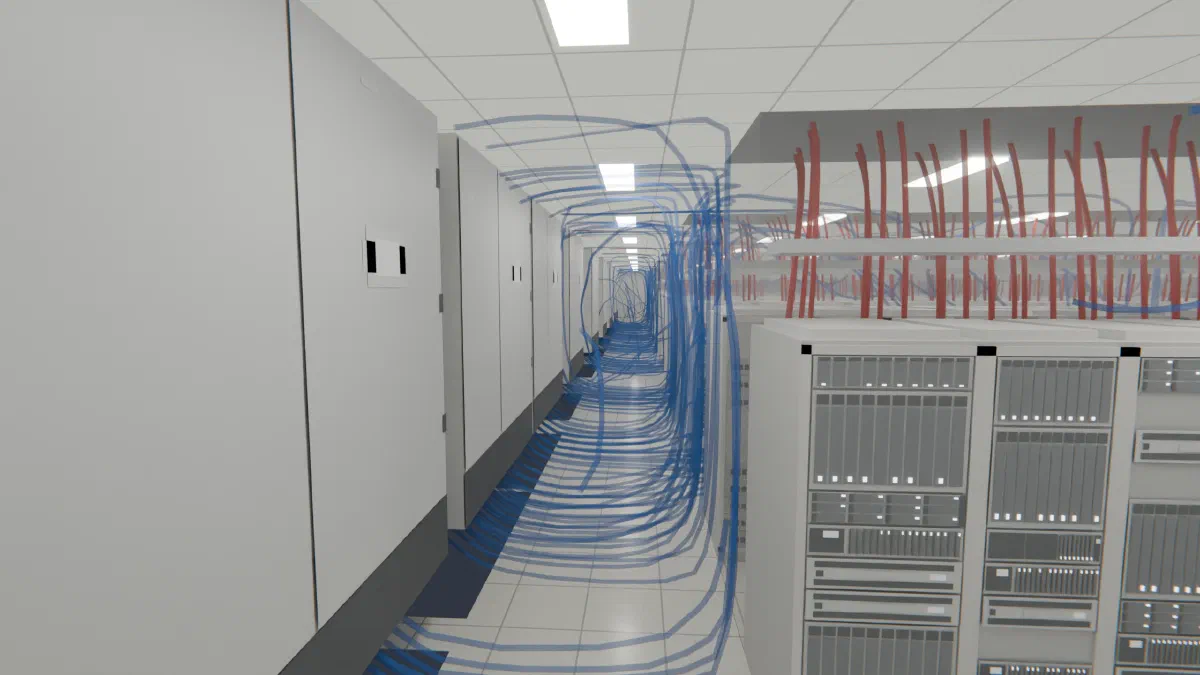

Cooling units and server fans are rated in CFM, cubic feet of air per minute. Heat, though, is carried by the mass of the air, and the air at altitude has less mass in every cubic foot. A hall in Denver that moves the same CFM as a hall at the coast removes about 18% less heat from its racks, or lets the air warm about 21% more across them.
What carries the heat
The heat a stream of air carries is
where is the air density, its specific heat (about 1.006 kJ/kg·K, nearly constant), the volume flow and the temperature rise. A fan sets . The load sets . So the air must rise by , and when falls, rises in proportion.
How thin the air gets
Pressure falls with elevation (in meters) in the troposphere as kPa. This is the troposphere form of the International Standard Atmosphere (ICAO and US Standard Atmosphere), the same barometric relation that ASHRAE Handbook—Fundamentals gives for pressure at altitude. We computed density from the ideal gas law at that pressure for dry intake air at 75 °F (24 °C):
| Location | Elevation | Pressure | Air density | Thinner than sea level |
|---|---|---|---|---|
| Sea level | 0 m (0 ft) | 101.3 kPa | 1.188 kg/m³ | 0% |
| 1,000 m (3,280 ft) | 89.9 kPa | 1.054 kg/m³ | 11.3% | |
| Salt Lake City | 1,288 m (4,226 ft) | 86.8 kPa | 1.017 kg/m³ | 14.4% |
| Denver | 1,609 m (5,280 ft) | 83.4 kPa | 0.978 kg/m³ | 17.7% |
| Johannesburg | 1,753 m (5,751 ft) | 82.0 kPa | 0.961 kg/m³ | 19.1% |
| Mexico City | 2,240 m (7,350 ft) | 77.2 kPa | 0.905 kg/m³ | 23.9% |
| Bogotá | 2,640 m (8,661 ft) | 73.4 kPa | 0.860 kg/m³ | 27.6% |
City elevations are round public figures, and sources differ by tens of meters depending on whether they measure the city center or the airport. The point is the size of the effect: every 1,000 m costs about 11% of the air’s mass.
Worked example: one rack
Take a 10 kW rack whose servers move 1,600 CFM (0.755 m³/s). At sea level the air warms by 11.1 K (20.0 °F) passing through it. Hold the CFM constant and the rise at each elevation is:
| Location | Air rise across the rack | Extra rise vs. sea level |
|---|---|---|
| Sea level | 20.0 °F (11.1 K) | |
| Salt Lake City | 23.3 °F (12.9 K) | +17% |
| Denver | 24.2 °F (13.5 K) | +21% |
| Johannesburg | 24.7 °F (13.7 K) | +24% |
| Mexico City | 26.2 °F (14.5 K) | +31% |
| Bogotá | 27.5 °F (15.3 K) | +38% |
A rack that sends 95 °F (35 °C) exhaust into the hot aisle at sea level from 75 °F (24 °C) intake sends out about 99 °F (37.3 °C) in Denver. One caveat: real servers do not hold CFM. Their fans speed up as the chips warm, which pulls the rise back down, at the cost of more fan power and noise, and some servers cannot reach the CFM they would need. Fan speed makes up part of the gap, not all of it. Server manufacturers publish altitude limits and derating for this reason.
Worked example: a cooling unit
The same factor cuts a cooling unit’s sensible capacity. A unit moving 20,000 CFM with a 20 °F (11.1 K) air-side temperature difference removes 125 kW at sea level. At fixed CFM and the same temperature difference:
| Location | Sensible capacity | CFM needed for 125 kW |
|---|---|---|
| Sea level | 125 kW | 20,000 |
| Denver | 103 kW | 24,300 |
| Mexico City | 95 kW | 26,300 |
| Bogotá | 91 kW | 27,600 |
At Denver the unit needs about 21% more airflow to do the same job. A unit that is only just big enough on the nameplate is short on site, and a shortfall on the cooling side shows up as hot spots on the floor. A manufacturer’s altitude correction for a specific unit is the number to use for a purchase.
ASHRAE derates the temperature limits
Thinner air also cools the chips less well, so ASHRAE lowers the allowable intake temperature. The 2021 thermal guidelines reference card (TC 9.9, Fifth Edition) says to reduce the maximum allowable dry-bulb temperature above 900 m (about 2,950 ft):
- Classes A1 and A2: 1 °C per 300 m.
- Class A3: 1 °C per 175 m.
- Class A4: 1 °C per 125 m.
The card also notes that above 2,400 m the derated temperature takes precedence over the recommended range. It sets a 3,050 m (10,000 ft) maximum elevation, and above that equipment needs the supplier’s agreement. Applied to the same locations:
| Location | A1 allowable | A2 allowable | A3 allowable | A4 allowable |
|---|---|---|---|---|
| Sea level | 89.6 °F (32.0 °C) | 95.0 °F (35.0 °C) | 104.0 °F (40.0 °C) | 113.0 °F (45.0 °C) |
| Denver | 85.3 °F (29.6 °C) | 90.7 °F (32.6 °C) | 96.6 °F (35.9 °C) | 102.7 °F (39.3 °C) |
| Mexico City | 81.5 °F (27.5 °C) | 86.9 °F (30.5 °C) | 90.1 °F (32.3 °C) | 93.7 °F (34.3 °C) |
| Bogotá | 79.2 °F (26.2 °C) | 84.6 °F (29.2 °C) | 86.2 °F (30.1 °C) | 88.0 °F (31.1 °C) |
In Bogotá the A1 allowable limit, 26.2 °C, is already below the 27 °C top of the recommended range. So altitude hits twice: the air rises more across the rack, and the ceiling it is allowed to reach is lower.
What a model has to do
A CFD model solves for mass and energy. If the room’s air density is set for sea level while the site sits at 1,600 m, the model carries too much mass for every CFM and under-reports every temperature rise. For the Denver rack above it would show 11.1 K when the air would rise 13.5 K, a 2.4 K (4.3 °F) error in the hot aisle, and nothing in the geometry would look wrong.
CoolSim computes air density from temperature with the ideal gas law at the air pressure for the site’s altitude, as the what is CFD article describes. The thing to do when building a model is to enter the site’s elevation, so it takes the pressure from the standard atmosphere.
Where to go from here
If your hall is above 900 m, check three things: the density your model uses, the airflow your cooling units can deliver on site, and the derated ASHRAE limit for your equipment class. The How we know it’s right page describes how the models are checked, and the contact page is the place to ask about a site at altitude.