When you refine the mesh of a data hall model, the averages stop changing before the hot spots do. The hottest spot on a rack intake is what decides pass or fail, so an average that agrees across meshes is not yet evidence that the answer has. And once the mesh is good enough, the next question is bigger: is the model the room you meant?
One room, three meshes
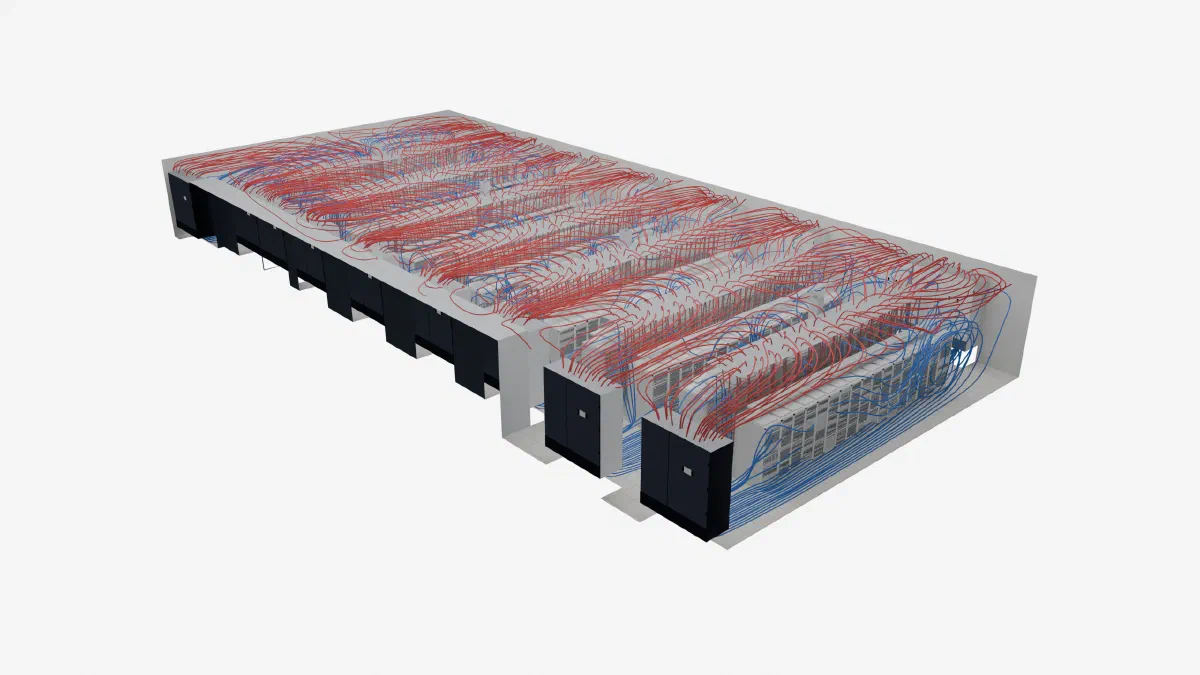
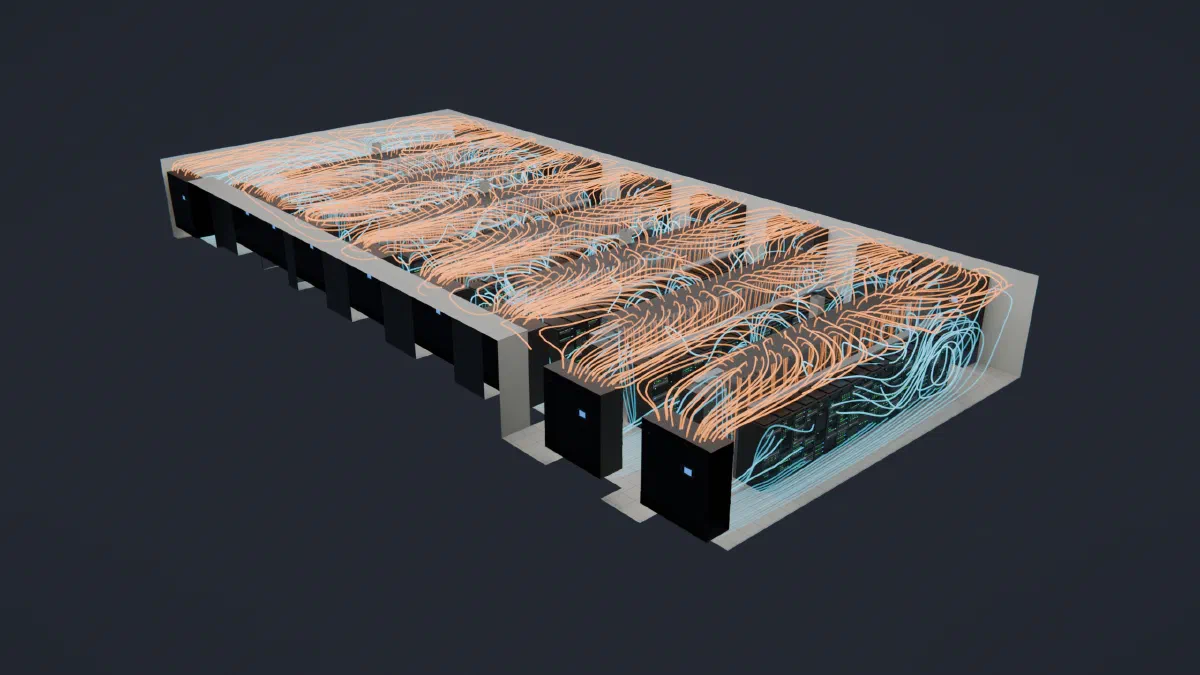
We solved one synthetic room three times: twelve 10 kW racks in two rows, with cold-aisle containment and perforated tiles. The three meshes are our Quick, Standard and Detailed levels, each roughly halving the cell size, with 30,086, 121,353 and 561,780 cells. Detailed has about 19 times the cells of Quick.
| Quick | Standard | Detailed | |
|---|---|---|---|
| Hottest rack inlet | 78.1 °F (25.6 °C) | 79.9 °F (26.6 °C) | 84.1 °F (28.9 °C) |
| Racks above 80.6 °F (27 °C) | 0 | 0 | 2 |
| Largest single-rack change in average inlet vs. Detailed | 1.6 °F | 0.9 °F | |
| Largest single-rack change in hottest inlet vs. Detailed | 7.0 °F | 6.2 °F |
Look at the third and fourth rows together. Averaged over each rack’s intake face, no rack moves by more than 1.6 °F between the coarsest mesh and the finest. The warmest single spot on the same faces moves by up to 7.0 °F. At Quick and Standard the room passes with every rack under 80.6 °F, and at Detailed two racks are over.
Why the hot spot is slower to settle
An average blends the whole intake face. A hot spot is one small patch where a thin stream of warm air touches the face. That stream is a few cells wide on a coarse mesh and is smeared across its neighbors, so its peak is flattened. Refine the mesh and the stream gets narrower and warmer, and the average barely notices.
So decide which number the question is about. If it is how much cooling the room needs, averages are enough, and a coarse mesh will do. If it is whether every intake stays under a limit, the hottest spot is the number, and you need a mesh ladder to know it.
What a mesh ladder tells you
A mesh ladder is the same model solved on three meshes. Compare the quantity you will report, not a convenient one. If the hottest inlet on the finest two meshes agrees to within what you can tolerate, you have a result. If it does not, a pass at the coarse level is a hope, not a finding. In the room above, nobody reading only the first two columns would have guessed the third.
Each of these runs also has to be settled before you compare it. We continued each run past our stopping point so that the differences in the table come from the mesh and not from stopping early.
The bigger question: is it the room you meant?
Mesh error is the error you can shrink by spending cores. Geometry error is the error of solving a different room. It is usually larger.
Take the same twelve racks and change only the containment. With no containment, the hottest rack inlet is 106.3 °F (41.3 °C) and all 12 racks are above 80.6 °F. With cold-aisle containment it is 79.9 °F with none above. With hot-aisle containment and 5 percent open end caps it is 92.3 °F (33.5 °C) with 2 above. Those are differences of 12 to 26 °F, compared with a mesh-driven change of up to 7.0 °F in a single rack of the cold-aisle room.
The detail that is easy to get wrong is as small as an end cap. In the hot-aisle room, doubling the end-cap opening from 5 to 10 percent raised the average temperature of the room outside the rows from 78.7 °F (25.9 °C) to 84.1 °F (28.9 °C), a 5.4 °F rise. The number of racks over 80.6 °F went from 2 to 3. The single worst rack got slightly cooler, 92.3 to 90.5 °F, so even the direction of the change depended on which number you read. An end cap is a panel with a gap that someone has to choose, and the choice is worth more than a mesh step.
What to do with it
Build the model the way the room is built: the real end caps, the real leaks, the real tile open area. Then check the mesh on the number you will report, with a ladder, and check that each run has settled. In that order the work is cheap, because a correct model needs only a good-enough mesh, and a wrong model gets no better on a finer one.
For the basics, see what is CFD, and for geometry in more depth, WP104: Improving Model Geometry for CFD Analysis and WP107: Using CFD for Data Center Design and Analysis. For how we check our own results, see how we know it’s right.